
Software
Microsoft SQL Server Management Studio (SSMS) remains the go-to tool for database administrators and developers. This timeline explores 10 key versions, highlighting their major features, compatibility changes, and how they evolved to meet modern database management needs.
SQL Server Management Studio 18.0

If you're managing SQL Server 2019 or need the latest tooling for modern database workflows, SSMS 18.0 is your best bet. Released as the final stable version before Microsoft shifted focus to Azure Data Studio, it delivers a polished experience with deep integration for SQL Server 2019's advanced features.
Key improvements include enhanced IntelliSense with faster autocomplete for complex queries, query performance insights via the Execution Plan XML feature, and streamlined connection management for hybrid environments. The interface also supports dark mode and includes minor UI refinements that reduce visual clutter. Developers will appreciate the lightweight installer (under 1GB) and optional components for custom deployments.
This version is ideal for SQL Server 2019 administrators and developers who rely on SSMS's mature feature set while avoiding Azure Data Studio's learning curve. Its backward compatibility ensures it works with SQL Server 2016+ while offering the latest tooling. ⚡
SQL Server Management Studio 17.9
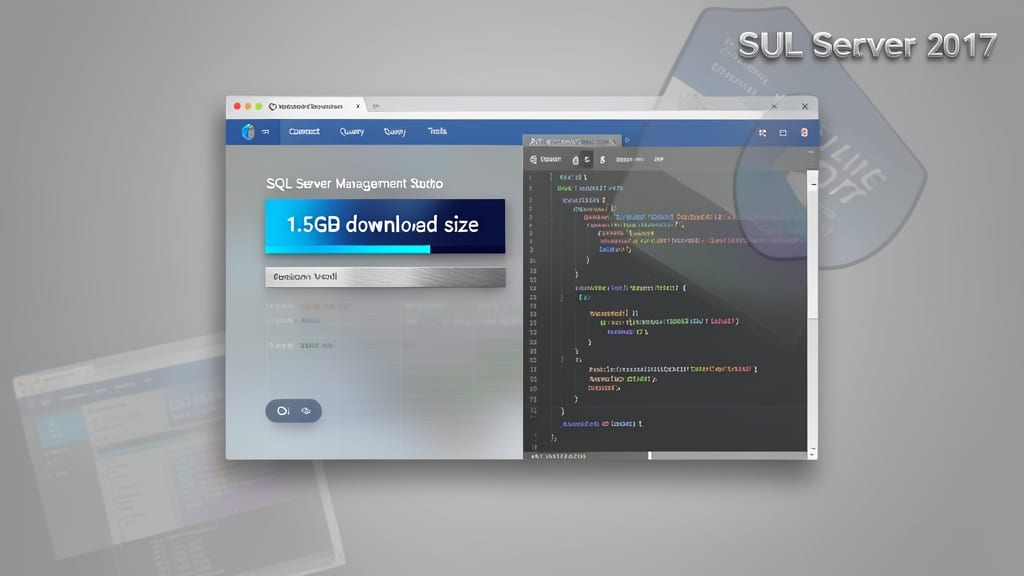
If you’re managing SQL Server 2017 but need a leaner tool than the full SSMS suite, version 17.9 delivers exactly that. This was the final release dedicated to SQL Server 2017, but its real standout feature was the lightweight installer—shrinking the footprint from 2.5GB to just 1.5GB while preserving core functionality.
The lightweight option lets developers install only the tools they need, skipping bloat like documentation or sample databases. It retained full compatibility with SQL Server 2017 while offering a faster, more efficient setup—ideal for environments where bandwidth or storage is limited. Microsoft’s focus here was clear: give developers control over their toolchain.
Perfect for small teams or solo developers working with SQL Server 2017 who want to avoid unnecessary overhead. If you’re upgrading past 2017, though, SSMS 18.0+ is the way to go. ⚡
SQL Server Management Studio 17.8

If you've ever juggled multiple tools to manage SQL Server databases across Windows and Linux, SSMS 17.8 was your game-changer. This version introduced the first native Azure Data Studio integration, letting you switch between platforms without losing functionality.
The key innovation was the ability to seamlessly sync queries and results between SSMS (Windows-only) and Azure Data Studio (cross-platform). You still got full SQL Server 2017 compatibility, but now with the flexibility to work on macOS or Linux systems when needed. The integration preserved all existing SSMS features while adding Azure Data Studio's lightweight, modern UI for cloud-based management.
This version was ideal for hybrid cloud teams or developers working across mixed environments, offering the best of both worlds without sacrificing performance or compatibility. ✨
SQL Server Management Studio 17.7

If you're working with modern data formats like JSON or need enterprise-grade encryption, SSMS 17.7 is the version that bridges the gap between legacy SQL and today's requirements. This release introduced native JSON import/export capabilities, letting you seamlessly move between relational and NoSQL data without third-party tools.
The Always Encrypted feature received major upgrades, including better key management and performance optimizations for sensitive workloads. You can now encrypt entire columns at rest and in use, with minimal impact on query speed—a game-changer for healthcare, finance, or compliance-heavy industries. The SQL Server 2016/2017 compatibility ensures it’s future-proof for most production environments.
Developers handling hybrid APIs or microservices will find this version indispensable, while security teams appreciate the streamlined encryption workflows. For those stuck between legacy systems and modern needs, 17.7 delivers the best of both worlds. ✨
SQL Server Management Studio 17.4

If you're managing SQL Server 2017 on Linux, SSMS 17.4 is the game-changer you’ve been waiting for. This update wasn’t just about fixing bugs—it was about bridging the gap between Windows and Linux environments with purpose-built tools for hybrid setups.
For the first time, SSMS 17.4 introduced native Linux support for SQL Server 2017, complete with Linux-specific query tools and streamlined connection management. The SSH-based connection handling eliminated the need for VPNs or complex network configurations, while enhanced query execution plans provided deeper insights into Linux-hosted databases. Developers could now write, test, and debug queries seamlessly across platforms—no more context-switching between tools.
This version is a must-have for DevOps teams or sysadmins running mixed Windows/Linux environments. Whether you're debugging a query on a Ubuntu VM or managing a hybrid cloud deployment, SSMS 17.4 turns Linux into a first-class citizen in your SQL ecosystem. ⚡
SQL Server Management Studio 17.3

If you're a DevOps engineer tired of jumping between tools to automate SQL Server tasks, SSMS 17.3 is your game-changer. This version introduced native PowerShell script execution directly within the SSMS interface, eliminating the need for external consoles or manual script imports.
The integration lets you run PowerShell cmdlets like Invoke-Sqlcmd or New-SqlDatabase without leaving SSMS, streamlining workflows for database deployments, maintenance scripts, and CI/CD pipelines. Compatible with SQL Server 2016-2017, it bridges the gap between administration and automation for teams managing hybrid environments.
Perfect for DevOps teams using PowerShell for database provisioning, this version reduces context-switching and simplifies script debugging. 💻
SQL Server Management Studio 16.5

When handling financial records or patient data, SSMS 16.5 introduced a game-changer: Always Encrypted with secure enclaves. This feature encrypts sensitive data at rest and in use, ensuring even database administrators can't access plaintext values—only authorized applications can.
The secure enclaves technology (built into SQL Server 2016 SP1+) offloads decryption to a trusted execution environment, preventing unauthorized access even if your server is compromised. For compliance-heavy industries, this means HIPAA and PCI DSS requirements become far more manageable without sacrificing performance. The update also refined Always Encrypted's query experience, reducing compatibility friction with legacy applications.
This version is a must for healthcare IT teams, fintech developers, and compliance officers managing regulated databases. If your workload involves PII or PHI, SSMS 16.5’s encryption stack provides the strongest protection available at the time. ✨
SQL Server Management Studio 16.1
If you're managing SQL Server 2016 databases, SSMS 16.1 was the first tool designed specifically for it—bridging the gap between legacy and modern SQL Server features. This version introduced temporal database tables, allowing you to track historical data changes without complex triggers or manual logging.
The Query Store received a major upgrade here, letting you monitor query performance trends over time with automatic capture of execution plans and runtime statistics. This made troubleshooting slow queries far more intuitive, especially for databases handling high transaction volumes. The lightweight installer also made it easier to deploy across development environments.
Perfect for database administrators migrating from older SQL Server versions or adopting SQL Server 2016's new features like stretch databases and row-level security. It remains a reliable choice for legacy systems needing modern performance tools. ✨
SQL Server Management Studio 2014

SQL Server Management Studio 2014 marked a turning point for enterprise database reliability with its groundbreaking AlwaysOn availability groups feature. This version transformed high-availability setups by enabling seamless failover across multiple replicas, ensuring near-zero downtime for mission-critical applications.
Beyond failover, SSMS 2014 introduced In-Memory OLTP capabilities, allowing in-memory processing for transactional workloads with up to 10x performance gains. The SQL Server 2014 compatibility made it the first version to fully support this architecture, while also refining backup compression and tiered storage options for cost-efficient data management.
Database administrators managing enterprise-grade systems—especially those requiring 24/7 uptime—found SSMS 2014 indispensable for building resilient database infrastructures. 💪
SQL Server Management Studio 2012

If you’ve ever missed the simplicity of a unified interface for SQL Server management, SSMS 2012 was the game-changer. Released alongside SQL Server 2012, this version consolidated previously separate tools like SQL Server Query Analyzer, Enterprise Manager, and Database Diagram Tools into one sleek, intuitive workspace.
The standout feature was its script editor with IntelliSense, which provided real-time code suggestions, syntax highlighting, and error detection—features that had been missing in earlier versions. It also introduced basic PowerShell integration, allowing you to automate repetitive tasks directly from the interface, a first for SSMS. These innovations made database development faster and more efficient for teams working with SQL Server 2012 and 2008 R2.
Perfect for developers and DBAs maintaining legacy systems, SSMS 2012 remains a nostalgic favorite for those who appreciate its clean, no-frills design and foundational features. 💻